Spread the word!

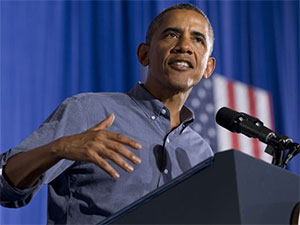
barack obama

The 2013 State of the Union Preview: Higher Ed

For Student Power will be covering the SOTU live, via Twitter and Facebook. Join in!

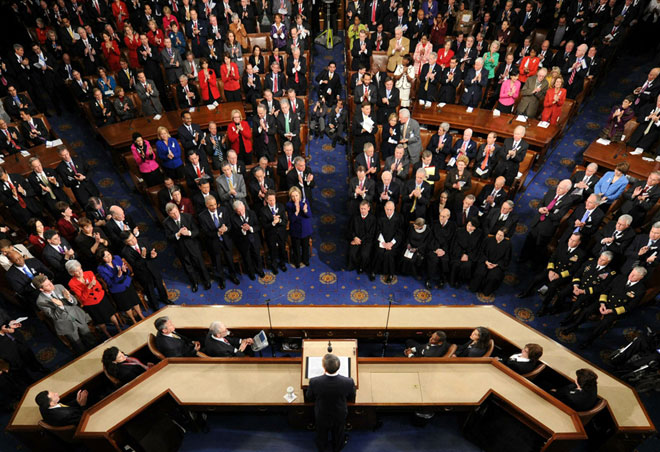
The annual State of the Union Address is a key aspect of the political spectacle of the modern Presidency. While the SOTU is actually a codified mandate in the U.S. Constitution, only in the 20th Century has it become a regular (and now annual) speech delivered to Congress — previously it had generally been a written document sent and read by a clerk. While the first broadcast SOTU was Calvin Coolidge's in 1923, via radio, the Address' central position in American political life was cemented with the first TV broadcast of Harry Truman's speech in 1947.

It's in these addresses that Presidents announce new policy goals, attempt to shore up public support, try out new narrative and rhetorical frames to shape the political landscape for the coming year, and in most cases, assiduously avoid going into detail.

When it comes to Higher Education, the U.S. Federal government plays a much more hands-off role than most other nations. Because Federal support of public higher education has always assumed state establishment, regulation, and control (starting with the Morrill Land-Grant Acts of 1862 and 1890), much of what can be done at the Federal level has to do with funding. What little rule-making is done is usually in the context of eligibility tests for funds (like the atrocious Solomon Amendment).

The usual suspects in Federal higher ed policy debates are loan and grant programs — Pell, Stafford, Perkins, PLUS, etc. Proposals often deal with them at one or both ends: how much the students get, and how much they have to pay back. While there is usually tweaking of the size of Pell grants or Stafford Loans, nobody expects them to approach the percentage of tuition cost that they once did. One modest improvement enacted in 2010 is that Pell grant increases are now automatic, and pegged to the rate of inflation + 1%. That being said, Pell grants are now limited to 12 full-time semesters (down from 18), and the maximum award of $5,500 will now only be automatically granted is your family income is below $23,000 (down from $30k). In addition, for graduate students, Stafford Loans will no longer be subsidized (i.e. accrued interest is no longer waived during your time in school or during deferment). Bad news for the students who need financial support the most.

However, the biggest policy shift over the past four years has been the expansion and refinement of the Income-Based Repayment Plan (IBR). For those who can enroll, IBR caps loan payments at a percentage of your income and forgives whatever's left on the loan after a certain number of years (notably this does not apply to private loans, which can be the harshest burdens of all). As of right now, for most with student loans, IBR is capped at 15% of your income over 25 years. Congress changed that, so starting in 2014 (and for a select few qualifying students, right now) the cap will be 10% of your income over 20 years.

One danger that looms on the horizon for higher ed is the potential importation of the horrendous corporate-style ed reform currently infecting K-12 policy across the country. Pushing universal standardized tests on all colleges was a dream of the Bush Administration, and similar moves are being attempted in at the state level. Be on the lookout for "accountability" being posited as a solution to every ill, from high tuition costs to low graduate employment. 

Since this site is called "For Student Power" after all, I feel obligated to point out that issues of power never, ever come up in higher ed policy, and certainly never in a rhetorical event like a SOTU — except in the shallowest of forms, consumer power. Sure, we all rolled our eyes when Mitt Romney told students to "shop around" as a solution to the tuition and debt crisis. But how much better is Obama's vision? "Shop around — and here's a coupon, too." The closest he ever got to tackling tuition itself was the hilariously backward idea that universities should lower their tuition or face a reduction in federal funds and subsidies: a kind of punishment one could very well imagine a vulture capitalist like Romney coming up with.

There are lots of policies Obama could propose that actually would improve students' lives and create capacity for greater power. For example, he could mandate that student activity fees must be exclusively under the control of student-elected and -governed bodies (a hard-fought right that has steadily eroded away over the past few decades). Hell, that'd even help him and his party at the polls, since student governments and their larger associations often do a ton of voter registration and GOTV.

As for what Obama will say tonight, we can only guess — but to help us make an educated one, below are the relevant SOTU passages about higher ed for the last four years:

2009:

Because of this plan, families who are struggling to pay tuition costs will receive a $2,500 tax credit for all four years of college. 

In the wake of war and depression, the GI Bill sent a generation to college and created the largest middle-class in history.

And half of the students who begin college never finish.

This is a prescription for economic decline, because we know the countries that out-teach us today will out-compete us tomorrow.  That is why it will be the goal of this administration to ensure that every child has access to a complete and competitive education – from the day they are born to the day they begin a career.

We have made college affordable for nearly seven million more students.

And so tonight, I ask every American to commit to at least one year or more of higher education or career training.  This can be community college or a four-year school; vocational training or an apprenticeship.  But whatever the training may be, every American will need to get more than a high school diploma.  And dropping out of high school is no longer an option.  It’s not just quitting on yourself, it’s quitting on your country – and this country needs and values the talents of every American.  That is why we will provide the support necessary for you to complete college and meet a new goal:  by 2020, America will once again have the highest proportion of college graduates in the world.

I know that the price of tuition is higher than ever, which is why if you are willing to volunteer in your neighborhood or give back to your community or serve your country, we will make sure that you can afford a higher education.  And to encourage a renewed spirit of national service for this and future generations, I ask this Congress to send me the bipartisan legislation that bears the name of Senator Orrin Hatch as well as an American who has never stopped asking what he can do for his country – Senator Edward Kennedy.

2010:

Still, in this economy, a high school diploma no longer guarantees a good job. I urge the Senate to follow the House and pass a bill that will revitalize our community colleges, which are a career pathway to the children of so many working families. To make college more affordable, this bill will finally end the unwarranted taxpayer-subsidies that go to banks for student loans. Instead, let’s take that money and give families a $10,000 tax credit for four years of college and increase Pell Grants. And let’s tell another one million students that when they graduate, they will be required to pay only ten percent of their income on student loans, and all of their debt will be forgiven after twenty years – and forgiven after ten years if they choose a career in public service. Because in the United States of America, no one should go broke because they chose to go to college. And it’s time for colleges and universities to get serious about cutting their own costs – because they too have a responsibility to help solve this problem.

2011:

America has fallen to 9th in the proportion of young people with a college degree. And so the question is whether all of us – as citizens, and as parents – are willing to do what’s necessary to give every child a chance to succeed.

Of course, the education race doesn’t end with a high school diploma. To compete, higher education must be within reach of every American. That’s why we’ve ended the unwarranted taxpayer subsidies that went to banks, and used the savings to make college affordable for millions of students. And this year, I ask Congress to go further, and make permanent our tuition tax credit – worth $10,000 for four years of college.

Because people need to be able to train for new jobs and careers in today’s fast-changing economy, we are also revitalizing America’s community colleges. Last month, I saw the promise of these schools at Forsyth Tech in North Carolina. Many of the students there used to work in the surrounding factories that have since left town. One mother of two, a woman named Kathy Proctor, had worked in the furniture industry since she was 18 years old. And she told me she’s earning her degree in biotechnology now, at 55 years old, not just because the furniture jobs are gone, but because she wants to inspire her children to pursue their dreams too. As Kathy said, “I hope it tells them to never give up.”

If we take these steps – if we raise expectations for every child, and give them the best possible chance at an education, from the day they’re born until the last job they take – we will reach the goal I set two years ago: by the end of the decade, America will once again have the highest proportion of college graduates in the world.

One last point about education. Today, there are hundreds of thousands of students excelling in our schools who are not American citizens. Some are the children of undocumented workers, who had nothing to do with the actions of their parents. They grew up as Americans and pledge allegiance to our flag, and yet live every day with the threat of deportation. Others come here from abroad to study in our colleges and universities. But as soon as they obtain advanced degrees, we send them back home to compete against us. It makes no sense.

Starting this year, no American will be forbidden from serving the country they love because of who they love. And with that change, I call on all of our college campuses to open their doors to our military recruiters and the ROTC.

2012:

Jackie Bray is a single mom from North Carolina who was laid off from her job as a mechanic. Then Siemens opened a gas turbine factory in Charlotte, and formed a partnership with Central Piedmont Community College. The company helped the college design courses in laser and robotics training. It paid Jackie’s tuition, then hired her to help operate their plant.

I want every American looking for work to have the same opportunity as Jackie did. Join me in a national commitment to train 2 million Americans with skills that will lead directly to a job. My administration has already lined up more companies that want to help. Model partnerships between businesses like Siemens and community colleges in places like Charlotte, and Orlando, and Louisville are up and running. Now you need to give more community colleges the resources they need to become community career centers -– places that teach people skills that businesses are looking for right now, from data management to high-tech manufacturing.

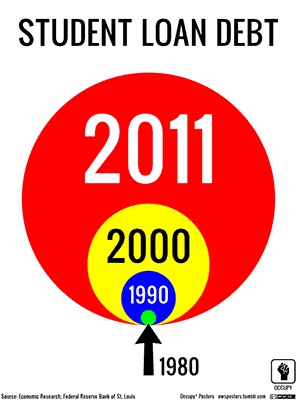
When kids do graduate, the most daunting challenge can be the cost of college. At a time when Americans owe more in tuition debt than credit card debt, this Congress needs to stop the interest rates on student loans from doubling in July.

Extend the tuition tax credit we started that saves millions of middle-class families thousands of dollars, and give more young people the chance to earn their way through college by doubling the number of work-study jobs in the next five years.

Of course, it’s not enough for us to increase student aid. We can’t just keep subsidizing skyrocketing tuition; we’ll run out of money. States also need to do their part, by making higher education a higher priority in their budgets. And colleges and universities have to do their part by working to keep costs down.

Recently, I spoke with a group of college presidents who’ve done just that. Some schools redesign courses to help students finish more quickly. Some use better technology. The point is, it’s possible. So let me put colleges and universities on notice: If you can’t stop tuition from going up, the funding you get from taxpayers will go down. Higher education can’t be a luxury -– it is an economic imperative that every family in America should be able to afford.

Let’s also remember that hundreds of thousands of talented, hardworking students in this country face another challenge: the fact that they aren’t yet American citizens.


For Student Power will be covering the SOTU live, via Twitter and Facebook. Join in!

DNC and RNC Education Platforms: from Bad to Worse

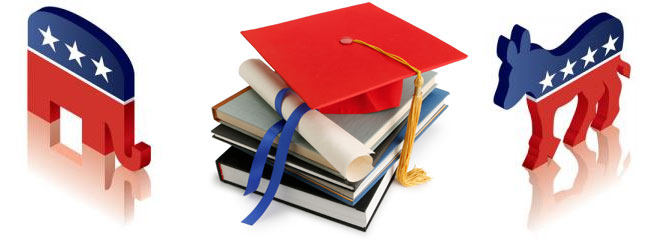
Now that the Democrats and Republicans have both released their 2012 party platforms, I took a look at each party's education planks (with stiff drink firmly in hand). Here's a bit of preliminary analysis.

The first thing that struck me was just how little was actually written on the Democratic side. Sure, substance is not just about word count (though the GOP's plank is 65% longer), but the difference is notable.

It's mostly touting Obama's reforms, and is very light on details for what a second term would hold from either the President or Congress. In their defense, incumbent parties usually take up a lot of space talking about their policy wins — the GOP did that in 2004, but their education plank then was more than twice as long as today's Dem plank.

Some of the Dem plank's internal contradictions are staggering. Here's their description of Race to the Top — which is an exercise in arm-twisting to all but force states to drastically expand charter schools, testing, and "merit" pay — cloaked in opposite words, like "flexibility."

President Obama and the Democrats are committed to working with states and communities so they have the flexibility and resources they need to improve elementary and secondary education in a way that works best for students. To that end, the President challenged and encouraged states to raise their standards so students graduate ready for college or career and can succeed in a dynamic global economy. Forty-six states responded, leading groundbreaking reforms that will deliver better education to millions of American students. 

And I was a bit surprised that they doubled down on what was probably the dumbest idea they proposed to tackle spiraling tuition costs:

President Obama has pledged to encourage colleges to keep their costs down by reducing federal aid for those that do not...

I tackled this ridiculous idea back when he proposed in in January. The idea is that colleges who can't keep tuition below the rate of inflation will face a cut federal aid (it's not clear if that's direct institutional aid, or aid to students who go there). It's a cousin of the equally ridiculous policy in many states that punishes low-performing K12 schools by cutting funding.

But often, the difference between Dem and GOP planks is merely one of tone:

GOP: Rigid tenure systems based on the “last in, first out” policy should be replaced with a merit-based approach that can attract fresh talent and dedication to the classroom. 
Dem: This includes raising standards for the programs that prepare our teachers, recognizing and rewarding good teaching, and retaining good teachers. We also believe in carefully crafted evaluation systems that give struggling teachers a chance to succeed and protect due process if another teacher has to be put in the classroom.

GOP: New systems of learning are needed to compete with traditional four-year colleges: expanded community colleges and technical institutions, private training schools, online universities, life-long learning, and work-based learning in the private sector.
Dem (2008 platform): At community colleges and training programs across the country, we will invest in short-term accelerated training and technical certifications for the unemployed and under-employed to speed their transition to careers in high-demand occupations and emerging industries. [...] We support education delivery that makes it possible for non-traditional students to receive support and encouragement to obtain a college education, including Internet, distance education, and night and weekend programs.

As a result, we see the Democratic platform is simply a mild-mannered version of the GOP platform. The GOP platform, sure, has some particularly rotten fruit — "we support the English First approach", vouchers and "choice," abstinence, online universities, attacking colleges as "zones of intellectual intolerance favoring the Left", and kulturkampf over religion and "cultural identity." But the two planks clearly are trees sharing the same roots.

Fundamentally, the framing used to understand problems and prescribe solutions in education is a bipartisan one: it's always about competition, and America competing with competitiveness in competitions with other competitors to out-compete each other to win (implied anti-China saber-rattling included, free of charge!).

Dem: "An Economy that Out-Educates the World"
GOP (2008): "Education Means a More Competitive America"

It's no surprise then, with framing like this, how easily right-wing education policies are held by Democrats and Republicans alike.

What might an actually progressive education plank look like?

There are a lot of things that could have been included in the Dem's education plank, especially since they really want — need — high youth turnout to keep the White House and win back Congress. Here are several (some more politically plausible than others):

  • Attack standardized testing, and all systems that link any benefits or penalties to them.
  • Propose returning most decision-making back to the classroom
  • Propose that students should have a significant presence on all school boards and administrative bodies.
  • Propose that any charter school operating with public funds must be a non-profit with a democratically-elected board.
  • Propose a constitutional amendment to ensure that all students receive an equitable, properly-funded, quality public education.
  • Propose a strengthening of student free-speech rights in K12 and college, which courts have been drastically eroding over the past decade.
  • Propose a serious student loan debt forgiveness program. Right now the current income-based loan repayment programs are confusing and underresourced, and only apply to Federal loans (no luck if you, like most of us, had to take out a ton of private loans).
  • Propose allowing student loan debt to be discharged in bankruptcy, like all other loans.
  • Propose that Federal student loans will be granted at drastically lower rates, perhaps the Prime Rate
  • Affirm that all public and private university employees — including grad students — have the right to organize under the NLRB.
  • Propose that any accredited university, in order for any of their students to receive federal education benefits, must be a non-profit.

I'm not holding my breath that we'll be seeing any of those bulletpoints coming from the White House anytime soon. It'll take a massive, multi-sector, non-electorally-focused student movement that can instill terror in the hearts of politicians to get any of this done. And that's exactly what we should be organizing around this fall semester, even in an election year — or as our friends in Québec might insist, especially in an election year.

Democratic and Republican Party Platforms: Education Planks, 2012 and 2008

Below is, for your reference, the education planks of the Democratic and Republican Party Platforms for 2012 and 2008.

Democrats: 2012 | 2008

Republicans: 2012 | 2008

From Student Debt to Student Power

I recently sat down with The Daily Agenda to chat about student loan debt and how it relates to larger activist movements on- and off-campus.


Patrick St. John is a graphic designer by trade and student organizer by love. Patrick has been organizing and agitating since high school; as an undergraduate at Moravian College, he continued to agitate for student rights and power as both Editor-in-Chief of the student newspaper and later as student government president (where he advocated abolishing the position).

Like so many other young Americans, he left school thousands of dollars in debt. During his off hours Patrick is still organizing and writing a book on student power. He blogs at forstudentpower.org.

We interview Patrick about the state of student debt and the prospects of breathing new life into the student movement.

DA: As student debt has now climbed to over a trillion dollars, who exactly benefits from having so many students owing so much money?

Patrick St. John: It’s always important to ask that question, because it’s certainly not the students and it’s clearly not the faculty. However one winner is the administration, including the Board of Trustees. The size of university administrations have soared over the past 40 years, far outpacing the regular growth of faculty and support staff.

There has been an increasing emphasis on running the university like a business. As a result you get a ton of administrative overhead and you get administrators who are more interested in growing the bottom line than in education. Right now a lot of campuses, especially the higher profile universities, hire President’s that have no experience in the classroom. They come from business backgrounds, or sometimes from the military or politics.

Often times funding decisions are not based on the consideration of the students or even the professors, but either the university in its quest for prestige or the vanity of big donors. You see this dynamic where trustees and other wealthy donors make donations that go into physical projects like new buildings, new facilities, or new sports stadiums. You can’t bolt a plaque onto a scholarship; but you can bolt a plaque onto a building. In the University of California system, the Regents have made it quite clear that they prefer tuition dollars over state-issued dollars, because they have much freer range in their use — so we see on campuses across the state massive physical projects, either completed and unused, or frozen in mid-construction. It’s yet another predictable result of the people most affected by university decisions having the least amount of say in making those decisions.

You also predictably see an increase in official corruption, with Trustee boards often including the heads of the very businesses the college contracts with (usually banks and construction firms).

DA: Do you detect any sort of change in what is being taught in our universities because of the increased role of private corporations in higher education?

PSJ: It’s a funny kind of feedback loop. On one end, as parents and students see rising increasing tuition combined with a sluggish economy, you see an emphasis on the “career ready majors”: the majors that are guaranteed to get a good-paying job above all else. Students begin asking themselves, “why am I taking this literature class when I could be taking another economics class?” It has that sort of effect.

On the other end of the feedback loop, universities are trying to attract more — and wealthier — students by touting the fact that “if you go here, we’re sure that you will get a job after you graduate.” There is actually an interesting case where a woman who attended a for-profit school went through school and of course racked up a ton of debt. When she graduated she sued the school because the school had essentially promised, through their advertising materials, that she would get a job. Her lawsuit failed, but the point she made is here to stay.

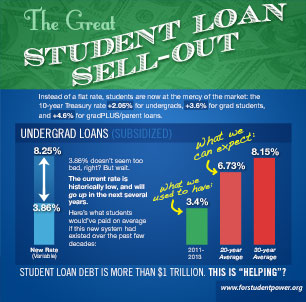
DA: Student loan debt rates are set to double in 8 days if Congress (at the time of this interview. It now appears that Congress will freeze student loan rates for one year). How meaningful are the Democrats’ proposals to stop this from happening?

PSJ: It’s a smart political move for Obama because he might be able to re-energize many of his supporters on his left flank. But we all need to be clear: this is not a fight between progressive and conservative policy positions. This is a fight between conservative and very conservative policy positions.

The interest rate on student loans is already too high, even at the current rate. For comparison, it’s roughly 450% more than the rate the Fed loans money to banks. The President is trying to spin this so that he can attach it to his “usual hope and change” mantra, when in reality it’s just a holding position. It’s keeping the conservative status quo intact in the face of something even more conservative and more corporate.

But there is a lot that he could do. He could lobby and push to allow student loan debt to be dischargeable in bankruptcy court. This could actually energize lots of students and alumni, those who are most pro-Obama but least likely to vote. There are many Democratic Senators and Congresspeople who are more progressive than Obama on this. So it’s not like this is something out of nowhere. It doesn’t tackle the systemic problem of why higher education is so unaffordable, but consumer-side student debt reform would be a step in the right direction.

DA: Among the four demands put out by the Occupy Student Debt movement was “a one-time debt forgiveness, or “jubilee.” What would this entail?


Read the rest of the interview at The Daily Agenda! >

One Year Later: Hope, Collapse, and Resistance

Barack Obama and George BushOne year ago Tuesday, Senator Barack Obama was elected as the United States' 44th President. For those of us with our ears to the ground on education issues - both primary/secondary and higher ed - we hoped for a change, especially because so much of Obama's primary and general election victory was won on the backs of countless students and youth volunteers.

The No Child Left Behind Act, which passed almost unanimously in the House and Senate, is widely regarded as a failure, and has done much to degrade the learning environment for students everywhere. Obama said much to that effect during the campaign, and one of his chief education advisors on his transition team was Dr. Linda Darling-Hammond, a Stanford education professor and an advocate for actually progressive education reform.

Arne Duncan: Business as Usual

But in the same way he appointed Wall Street suits to regulate their banking friends, Obama picked a corporate education suit to reform schools that were suffering from too much corporatization. When Arne Duncan was tapped for the post of Education Secretary, he was the CEO of Chicago Public Schools - a school district that had, under his close supervision, took the keys to the schoolyard away from teachers and parents and handed them to large corporate-funded non-profits, for-profit firms, and the U.S. military. He took his cues enthusiastically from Chicago's business elite, through their hand-crafted Renaissance 2010 project.

Arne Duncan - Renaissance 2010Duncan's rhetoric is taken wholesale from his Republican predecessors - the emphasis on "accountability", standardized tests, "raising the bar", "competing globally," and general paeans to the magic of the free market. He's even stated that schools should be run more like businesses. This point isn't lost on many - even EdWeek came right out and said that Obama's education policy is "giving George W. Bush a third term."

Since his arrival, Duncan has pushed for the very changes that hobbled education in his old job. He's argued against democracy and for all powers to be vested within a single executive (like his CEO position) in large urban school districts.

"Race to the Top" — If by "Top" You Mean "Bottom"

Obama's signature education initiative in his first year was the several billion dollar "Race to the Top" initiative. The idea is to dangle the carrot of Federal education dollars in front of schools and education officials, and have them compete with each other for them. In an economic and budgetary climate that's depriving tens of billions of dollars from states and school districts nationwide, the "Race to the Top" is essentially forcing them to adopt policies and priorities of Duncan's DoE: among them introducing and expanding charter schools (and removing any caps on charter school numbers), and establishing long-discredited "merit pay" schemes for teachers. Paul Rosenberg over at OpenLeft had a great takedown of these shenanigans, concluding that:

It's really hard to see this as anything other than a Shock Doctrine-style deal, since it's a way to force cash-starved states and schools to change education policy and practice, regardless of what they might normally and democratically choose to do.  And not only that--because the funds are limited, they could make the changes, and still not get a dime for doing so.

Progressive education reform would empower individual schools, teachers, and students to actively shape and determine their lives, and would equalize the enormous funding gap between affluent suburban school districts and working class urban school districts. This latest DoE scheme is just about as close to the opposite as one can get.

Higher Ed - two steps forward, two steps back

Slashed state budgets and withering private endowments have sent a shock through higher education, with tuition increases expected to accelerate even faster than they are now. On the plus side, Obama's stimulus bill provided roughly $30 billion in tax credits and expanded Pell grants to students.

The House of Representatives passed a bill (The Student Aid and Fiscal Responsibility Act) that would cut private lenders out of the Federal student loan program, which makes a ton of sense. It would reduce overhead (and profits), and turn those savings (estimated more than $80 billion over 10 years) into more Pell grants to go around. Obama has pledged to sign it, but it still needs to pass the Senate.

During the campaign, all three major Democratic candidates - Clinton, Edwards, and Obama - vowed to vigorously enforce the Solomon Amendment, which allows the President to cut off Federal funds to schools that bar ROTC or recruiters from campus (barred usually on the basis that they violate the school's anti-LGBT discrimination policy). We haven't seen any instance of Obama enforcing it just yet, but anecdotally I've seen the threat of it make things harder for students trying to demilitarize their campuses.

Although it didn't get a lot of play from traditional media outlets, the Pentagon is ramping up its involvement in University research. The new director for the Pentagon's research agency is putting a kinder, gentler face on the military-academic complex, while the DoD's Minerva Initiative and the National Science Foundation are setting up more than a dozen new military and "national security" contracts for social science research.

Resistance

Even before Obama had been sworn in, students were already resisting the corporatization of their schools - and articulating a vision of education beyond anything Democrats or Republicans could ever offer.

New School OccupiedOn December 11, 2008, a large contingent of New School University students in New York City occupied one of their campus buildings, demanding the resignation of their university's embattled President, Executive VP, and Treasurer, along with establishing a democratic election of their replacements, a socially responsible investment committee to oversee the school's endowment, and many other demands. While not all of their demands were met, some of them were (and later in 2009 we'd hear that NSU President Bob Kerrey is indeed planning on stepping down in 2010) - and more importantly, they laid the groundwork for future occupations, including a second New School occupation months later and an occupation at New York University.

In April of this year, one hundred students occupied administration offices at the University of Vermont just days after more than a thousand teachers and students staged a walkout - both actions condemning budget cutbacks and layoffs, especially when senior administrators are paid so much that a mere 5% pay cut for them would cover the salaries of the 27 laid off lecturers. After more than ten hours occupying the building, police dispersed the crowd and arrested 33 students. Thanks to a committed student body and campus union presence, the fight is ongoing, with multiple actions and protests since then.

UC Santa Cruz occupationOf course the most epic mark of resistance this year could be found in California this past fall. The UC system had announced that tuition and fees for in-state students would increase more than 30 percent over the next year, coming on the heels of a previous 9.3 percent hike announced in May. Hundreds of university employees are being laid off with most remaining employees subject to furloughs. On September 24, thousands of faculty, students and staff joined to protest the massive budget cuts to the state's university system -- and to protest the complicity of the university's administrations and the Board of Regents. That week saw actions, protests, and teach-ins on every UC campus. Students at UC Santa Cruz even occupied a university building for the better part of a week. And the actions continue: in October over six hundred California students converged for a conference on the education budget, and left it resolved to plan for a day of action next March - and that same month students at Fresno State held a massive walk-out and sit-in to make demands on their administration.

K-12 students, teachers, and parents are also banding together to take back their schools - from Los Angeles, to New York, to Washington DC, and many smaller, usually quiet communities in between. Independent, student-led groups are often taking the lead, like the Baltimore Algebra Project and the Philedelphia Student Union. Nationally, Students for a Democratic Society, re-established in 2006, has seen more than a hundred chapters spring up in high schools and colleges across the country, all dedicated on the premise that students deserve a free, quality, and democratic education where students and teachers - not administrators and officials - call the shots. Most chapters have held actions or are organizing against tuition hikes, layoffs, and budget cuts, and many are mobilizing for a Nov. 10 national day of action for free and liberating education for all.

There are many, many other examples of ordinary people organizing to take on the foundations of a dysfunctional education system - and that's telling in and of itself. While politicians in state and national capitals continue down the bipartisan road to ruin, folks on the ground in their own communities are working outside the ballot box to rescue themselves and build better schools - and a better world. While it would be nice if they helped, we're going to get there with or without President Obama and Congress.

Syndicate content