Spread the word!

student loans

Student Loan Debt: The Really F*cking Scary Number Hidden in the NY Fed Report

There's been quite a bit of chatter about the latest report on student loan debt out by the New York Federal Reserve Board. You can check out a PDF of the findings here. All the bad numbers are up: the total amount of student loan debt, the number of students taking out loans, and the number of those who have stopped repayment. But there's one figure that I haven't seen many people in the news really highlight, and it's the scariest. It's also buried in the second half of the report.

First off, the expected bad news:

Everyone across age groups now has significantly more student loan debt

Chart of total student loan balances by age group


Student loan debt is the only kind of debt that's consistently increased during the recession:

Chart of student loan debt vs other debt


There are a ton more borrowers, and the amount they're borrowing has leaped as well:

Chart of student loan borrowers and balance per borrower


Now here comes the truly scary part you've been waiting for. Below is a pie chart of those who have student loans, and what their repayment status is.

Chart of student loan borrower repayment status delinquent

At first glance, the percentage of those with delinquent balances seems pretty bad — 17%, one in six — but not the end of the world. But as the report casually mentions later in the report, this chart is deceptive in that it includes people who are not expected to make a monthly payment: either they're in school, or have a deferment or forbearance. So if we take those people out of the equation (the blue and purple slices), that modest 17% becomes a gigantic 30%! Join me in the next paragraph, as I reiterate this for dramatic effect.

ALMOST ONE OUT OF EVERY THREE PEOPLE WITH STUDENT LOANS DUE HAVEN'T MADE A PAID UP FOR MORE THAN 90 DAYS.

The Fed didn't create a pie chart highlighting this, so I went ahead and made one, because this is the number that shows how unsustainable our current system is. With other forms of debt, it's easy to see the breaking point: look at the bankruptcies. However, since Congress loves its Wall Street benefactors so much, student loan debt is (with very few exceptions) not dischargeable in bankruptcy. The 90+ day delinquency rate is the variable to watch for student debt.

Chart of student loan holders more than 90 days past due

Share this graphic on Facebook.

 If you haven't already begun organizing to wrench power away from those who are actively putting you in financial shackles, I reckon you ought to start.

From Student Debt to Student Power

I recently sat down with The Daily Agenda to chat about student loan debt and how it relates to larger activist movements on- and off-campus.


Patrick St. John is a graphic designer by trade and student organizer by love. Patrick has been organizing and agitating since high school; as an undergraduate at Moravian College, he continued to agitate for student rights and power as both Editor-in-Chief of the student newspaper and later as student government president (where he advocated abolishing the position).

Like so many other young Americans, he left school thousands of dollars in debt. During his off hours Patrick is still organizing and writing a book on student power. He blogs at forstudentpower.org.

We interview Patrick about the state of student debt and the prospects of breathing new life into the student movement.

DA: As student debt has now climbed to over a trillion dollars, who exactly benefits from having so many students owing so much money?

Patrick St. John: It’s always important to ask that question, because it’s certainly not the students and it’s clearly not the faculty. However one winner is the administration, including the Board of Trustees. The size of university administrations have soared over the past 40 years, far outpacing the regular growth of faculty and support staff.

There has been an increasing emphasis on running the university like a business. As a result you get a ton of administrative overhead and you get administrators who are more interested in growing the bottom line than in education. Right now a lot of campuses, especially the higher profile universities, hire President’s that have no experience in the classroom. They come from business backgrounds, or sometimes from the military or politics.

Often times funding decisions are not based on the consideration of the students or even the professors, but either the university in its quest for prestige or the vanity of big donors. You see this dynamic where trustees and other wealthy donors make donations that go into physical projects like new buildings, new facilities, or new sports stadiums. You can’t bolt a plaque onto a scholarship; but you can bolt a plaque onto a building. In the University of California system, the Regents have made it quite clear that they prefer tuition dollars over state-issued dollars, because they have much freer range in their use — so we see on campuses across the state massive physical projects, either completed and unused, or frozen in mid-construction. It’s yet another predictable result of the people most affected by university decisions having the least amount of say in making those decisions.

You also predictably see an increase in official corruption, with Trustee boards often including the heads of the very businesses the college contracts with (usually banks and construction firms).

DA: Do you detect any sort of change in what is being taught in our universities because of the increased role of private corporations in higher education?

PSJ: It’s a funny kind of feedback loop. On one end, as parents and students see rising increasing tuition combined with a sluggish economy, you see an emphasis on the “career ready majors”: the majors that are guaranteed to get a good-paying job above all else. Students begin asking themselves, “why am I taking this literature class when I could be taking another economics class?” It has that sort of effect.

On the other end of the feedback loop, universities are trying to attract more — and wealthier — students by touting the fact that “if you go here, we’re sure that you will get a job after you graduate.” There is actually an interesting case where a woman who attended a for-profit school went through school and of course racked up a ton of debt. When she graduated she sued the school because the school had essentially promised, through their advertising materials, that she would get a job. Her lawsuit failed, but the point she made is here to stay.

DA: Student loan debt rates are set to double in 8 days if Congress (at the time of this interview. It now appears that Congress will freeze student loan rates for one year). How meaningful are the Democrats’ proposals to stop this from happening?

PSJ: It’s a smart political move for Obama because he might be able to re-energize many of his supporters on his left flank. But we all need to be clear: this is not a fight between progressive and conservative policy positions. This is a fight between conservative and very conservative policy positions.

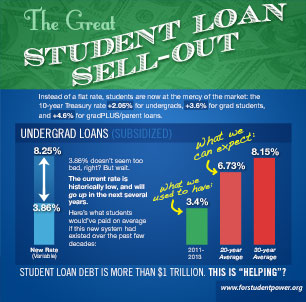
The interest rate on student loans is already too high, even at the current rate. For comparison, it’s roughly 450% more than the rate the Fed loans money to banks. The President is trying to spin this so that he can attach it to his “usual hope and change” mantra, when in reality it’s just a holding position. It’s keeping the conservative status quo intact in the face of something even more conservative and more corporate.

But there is a lot that he could do. He could lobby and push to allow student loan debt to be dischargeable in bankruptcy court. This could actually energize lots of students and alumni, those who are most pro-Obama but least likely to vote. There are many Democratic Senators and Congresspeople who are more progressive than Obama on this. So it’s not like this is something out of nowhere. It doesn’t tackle the systemic problem of why higher education is so unaffordable, but consumer-side student debt reform would be a step in the right direction.

DA: Among the four demands put out by the Occupy Student Debt movement was “a one-time debt forgiveness, or “jubilee.” What would this entail?


Read the rest of the interview at The Daily Agenda! >

Review of DEFAULT: The Student Loan Documentary

I left higher ed with roughly $50,000 in student loans. That debt, by way of the sometimes staggering monthly payments, has restricted where I can live, what I can do as a career (and specifically what kind of jobs I can afford to take), and what I can do with my free time.

That particular $50k was thanks to one single year of law school. One.

I was one of the lucky few as I left college -- I had zero student loan debt, a combination of commuting from home and tuition remission thanks to my father's faculty position. I had grand visions of walking in the footsteps of other radical lawyers, who eschewed the limousines and corner offices (and 100-hour work weeks) and instead used the law to at best help (at worst, mitigate the harm to) those most beaten down by the powers-that-be.

Syndicate content