Spread the word!

occupy wall street

From Student Debt to Student Power

I recently sat down with The Daily Agenda to chat about student loan debt and how it relates to larger activist movements on- and off-campus.


Patrick St. John is a graphic designer by trade and student organizer by love. Patrick has been organizing and agitating since high school; as an undergraduate at Moravian College, he continued to agitate for student rights and power as both Editor-in-Chief of the student newspaper and later as student government president (where he advocated abolishing the position).

Like so many other young Americans, he left school thousands of dollars in debt. During his off hours Patrick is still organizing and writing a book on student power. He blogs at forstudentpower.org.

We interview Patrick about the state of student debt and the prospects of breathing new life into the student movement.

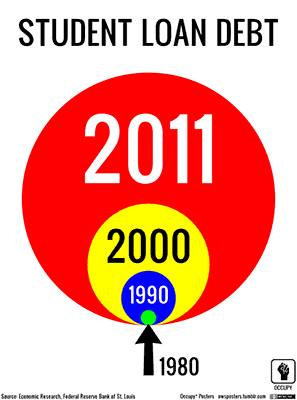
DA: As student debt has now climbed to over a trillion dollars, who exactly benefits from having so many students owing so much money?

Patrick St. John: It’s always important to ask that question, because it’s certainly not the students and it’s clearly not the faculty. However one winner is the administration, including the Board of Trustees. The size of university administrations have soared over the past 40 years, far outpacing the regular growth of faculty and support staff.

There has been an increasing emphasis on running the university like a business. As a result you get a ton of administrative overhead and you get administrators who are more interested in growing the bottom line than in education. Right now a lot of campuses, especially the higher profile universities, hire President’s that have no experience in the classroom. They come from business backgrounds, or sometimes from the military or politics.

Often times funding decisions are not based on the consideration of the students or even the professors, but either the university in its quest for prestige or the vanity of big donors. You see this dynamic where trustees and other wealthy donors make donations that go into physical projects like new buildings, new facilities, or new sports stadiums. You can’t bolt a plaque onto a scholarship; but you can bolt a plaque onto a building. In the University of California system, the Regents have made it quite clear that they prefer tuition dollars over state-issued dollars, because they have much freer range in their use — so we see on campuses across the state massive physical projects, either completed and unused, or frozen in mid-construction. It’s yet another predictable result of the people most affected by university decisions having the least amount of say in making those decisions.

You also predictably see an increase in official corruption, with Trustee boards often including the heads of the very businesses the college contracts with (usually banks and construction firms).

DA: Do you detect any sort of change in what is being taught in our universities because of the increased role of private corporations in higher education?

PSJ: It’s a funny kind of feedback loop. On one end, as parents and students see rising increasing tuition combined with a sluggish economy, you see an emphasis on the “career ready majors”: the majors that are guaranteed to get a good-paying job above all else. Students begin asking themselves, “why am I taking this literature class when I could be taking another economics class?” It has that sort of effect.

On the other end of the feedback loop, universities are trying to attract more — and wealthier — students by touting the fact that “if you go here, we’re sure that you will get a job after you graduate.” There is actually an interesting case where a woman who attended a for-profit school went through school and of course racked up a ton of debt. When she graduated she sued the school because the school had essentially promised, through their advertising materials, that she would get a job. Her lawsuit failed, but the point she made is here to stay.

DA: Student loan debt rates are set to double in 8 days if Congress (at the time of this interview. It now appears that Congress will freeze student loan rates for one year). How meaningful are the Democrats’ proposals to stop this from happening?

PSJ: It’s a smart political move for Obama because he might be able to re-energize many of his supporters on his left flank. But we all need to be clear: this is not a fight between progressive and conservative policy positions. This is a fight between conservative and very conservative policy positions.

The interest rate on student loans is already too high, even at the current rate. For comparison, it’s roughly 450% more than the rate the Fed loans money to banks. The President is trying to spin this so that he can attach it to his “usual hope and change” mantra, when in reality it’s just a holding position. It’s keeping the conservative status quo intact in the face of something even more conservative and more corporate.

But there is a lot that he could do. He could lobby and push to allow student loan debt to be dischargeable in bankruptcy court. This could actually energize lots of students and alumni, those who are most pro-Obama but least likely to vote. There are many Democratic Senators and Congresspeople who are more progressive than Obama on this. So it’s not like this is something out of nowhere. It doesn’t tackle the systemic problem of why higher education is so unaffordable, but consumer-side student debt reform would be a step in the right direction.

DA: Among the four demands put out by the Occupy Student Debt movement was “a one-time debt forgiveness, or “jubilee.” What would this entail?


Read the rest of the interview at The Daily Agenda! >

Malcolm Gladwell's Soft Authoritarianism

Malcolm Gladwell has folks in a bit of a tizzy over his latest New Yorker essay, "Small Change: Why the Revolution will not be Tweeted." A lot of excellent writing has come out as a result. Zeynep Tufekci makes a whole slew of good points, especially with her analysis of strong and weak ties. My friend Angus Johnston over at Student Activism offers a corrective to Gladwell's narrow understanding of 1960s history and expands the notion of "social networking" to come to more interesting conclusions about activist organizing, past and present. There's also a great discussion going on in the comments section of thisAtlantic review of the essay.

In the interests of not reinventing the wheel, I'd like to do my part by taking a crack at one aspect of the essay I haven't yet seen anyone specifically take on, and it goes to the core of many of his assumptions about the nature of humanity and society.

In "Small Change," Gladwell presents us with a classic logical fallacy: the false dilemma. Inside the historical picture he paints, we can only choose:

  1. Decentralized networks, which are only good at tinkering with the system, or

  2. Top-down, hierarchical structures, which are all that can work if you want fundamental social change.

This, sadly, is all too expected for a writer like Gladwell, who cut his chops in large newspapers covering business news. (Imagine if this topic was written about by someone whose 10,000 hours were actually in social change organizing.) He constantly switches between critiquing social media and critiquing decentralized organizing, conflating them: he talks about Twitter in one moment and the PLO in the next. This allows him to construct some straw men that actually look like very convincing arguments, buttressing an altogether shaky proposition:

The drawbacks of networks scarcely matter if the network isn't interested in systemic change—if it just wants to frighten or humiliate or make a splash—or if it doesn't need to think strategically. But if you're taking on a powerful and organized establishment you have to be a hierarchy. [...]

Because networks don't have a centralized leadership structure and clear lines of authority, they have real difficulty reaching consensus and setting goals. They can't think strategically; they are chronically prone to conflict and error. How do you make difficult choices about tactics or strategy or philosophical direction when everyone has an equal say?

Gladwell meant for that question to be a rhetorical one, but it's a question that gets answered every day by activists and organizers across the globe. It's a question I've had the privilege of answering with a dozen friends and comrades in cramped church basements, in huge meeting halls with hundreds of people, over email lists, and via phone.

Examples abound of powerful and often successful social movements that rely on decentralized and non-hierarchical structures. Stretching back in history:

  • The 2001 revolts in Argentina, which resulted in the toppling of three governments in as many weeks and the popular seizure and takeover of factories by their workers;
  • The 1999 Seattle WTO protests, which were successful by just about any measure (they shut down the WTO meeting and landed the first serious blow against the Washington Consensus);
  • The Zapatista revolution in Chiapas, Mexico in 1994, which was fundamentally opposed to hierarchical models both in the society they desired and in the groups they used to fight for it;
  • The massive, nationwide strikes and protests in France, May 1968, which caught all the hierarchical standard bearers of social change by surprise (the French Communist Party and the trade unions), and used the social media of the time (broadsheet newspapers and short-range radio) to coordinate the actions of tens of thousands at a time;
  • The Student Nonviolent Coordinating Committee (SNCC) in the 1960s, which, unlike King's SCLC, made decisions democratically among its members, using consensus process;
  • The early labor movement, which won great victories without any large institutional foundations or centralized leadership; and
  • The Underground Railroad, perhaps the best and most iconic counter-argument to Gladwell's insistence on the easy infiltration and defeat of decentralized networks.

Not only are there examples of democratic, decentralized social movements that succeeded, there are many counter-examples to Gladwell's paean to hierarchy. Just sticking to the Civil Rights movement: the Black Panther Party, which grew out of SNCC, was easily infiltrated and undermined in large part because of its rigid internal hierarchy and the secrecy among group elites that came with it. Gladwell's insistence that top-down is the only way to go has implications that reach far beyond the immediate subject of his essay. If the only functional organizations we encounter and participate in are hierarchical, then it's no surprise that we think such a model is a prerequisite for getting anything done. However history has also shown that anti-democratic means rarely result in democratic ends. How we organize is just as important as what we're organizing for, and thankfully we have plenty of more liberatory and empowering options than taking orders from the top.

I think Gladwell gets it right when he says that the revolution will not be tweeted. He is spot on when pointing out the media fabrication of the recent "Twitter revolts" in Iran and Moldova. Twitter and Facebook are tools that activists can use to supplement the tried-and-true tactics and strategies that have won victories for social movements in the past. They are a phenomenal way to access and augment the myriad weak ties that connect each of us to so many others. Any successful social movement will use these tools.

The revolution may not be tweeted, but I'm sure we'll get at least a few clever hashtags for it.

x-posted all over.

Syndicate content